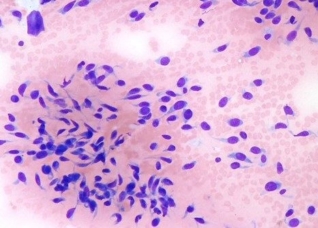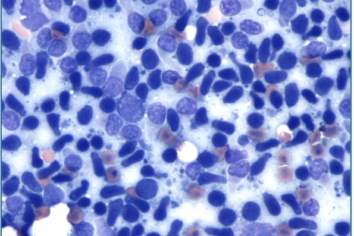


Figure 1. Large cell lymphoma (left), small cell lymphoma (right)
What are the key elements for a cytological diagnosis of lymphoma in dogs?:
Lymphoma is a neoplastic proliferation of lymphoid cells, most commonly encountered in lymphoid organs such as lymph nodes, but it may be observed in any organ. Diagnosis of lymphoma can be achieved via cytology in a large percentage of cases, making this technique a very effective, cheap, and non-invasive diagnostic procedure. But what are the hallmarks of lymphoma?
-
-
- Cell Population: Since lymphoma represents a neoplastic proliferation of a clone of neoplastic cells, the main feature is the presence of a monomorphic/homogenous population of lymphoid cells. This is in contrast to a reactive process, where a mixed population of lymphoid cells is expected.
- Cell Size: Lymphomas can be categorized as either small or large cell, depending on the cell size. Cell size is evaluated by comparing the lymphoid cell with a neutrophil:
- Small Cell: smaller than a neutrophil.
- Large Cell: larger than a neutrophil.
- Cell Size: Lymphomas can be categorized as either small or large cell, depending on the cell size. Cell size is evaluated by comparing the lymphoid cell with a neutrophil:
- Cell Population: Since lymphoma represents a neoplastic proliferation of a clone of neoplastic cells, the main feature is the presence of a monomorphic/homogenous population of lymphoid cells. This is in contrast to a reactive process, where a mixed population of lymphoid cells is expected.
-
Alternatively, the nucleus of the lymphoid cell can be compared with a red blood cell. Most lymphomas in dogs are multicentric (involving multiple peripheral lymph nodes) and are composed of large cells.
-
-
- Mitoses: These are evaluated in 10 high-power fields. Aggressive lymphomas are often associated with a large number of mitoses and are most commonly large cell, whereas indolent forms usually show no or few mitoses and are mainly composed of small lymphoid cells.
- Immunophenotype: in high grade canine multicentric lymphoma, immunophenotype (T vs B) has a prognostic significance. This cannot be accurately predicted via cytology, but can be assessed with ancillary techniques such as flow cytometry and immunocyto-histochemistry
-